From AI Prototype to Production Pipeline in Under Two Weeks
A growing VC fund had pieces of an AI-assisted deal evaluation process - scattered prompts, manual workflows, results they couldn't fully trust. Whitespectre turned that into a production-ready, multi-agent pipeline that evaluates incoming pitches in minutes, not hours.
SERVICES
Technical Architecture
AI Engineering
TECHNOLOGY
OpenAI
Python
Google Docs API
Slack API
HubSpot
In a Nutshell
Challenge: A VC fund raising its second fund was seeing incoming pitch volume grow faster than their assessment team could evaluate. Manual assessment took hours per pitch - longer for sectors outside the team's core expertise - and existing experiments with AI-assisted pitch evaluation were fragmented & inconsistent.
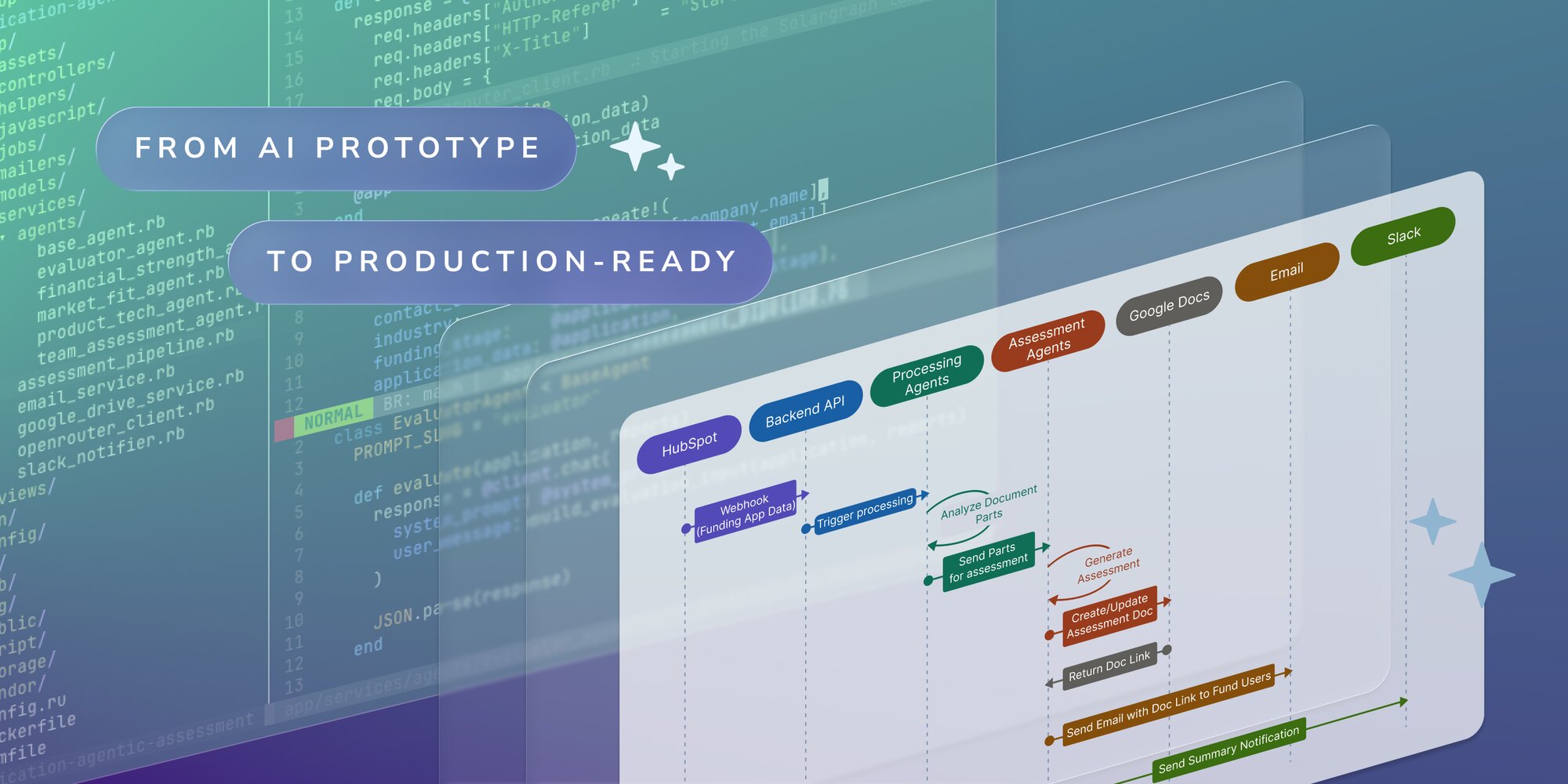
Solution: In two weeks, Whitespectre decomposed the fund's evaluation criteria into a multi-agent AI pipeline - each agent assessing a different dimension (financial feasibility, business fit, market positioning), with an orchestration layer that consolidates scores into a structured report via Google Docs integration, and delivers a go/review/pass signal via Slack.
Results:
- Production-ready pipeline delivered in under two weeks
- Evaluation time per pitch: minutes instead of hours
- 10x increase in pitch processing capacity
- Fund team can iterate evaluation criteria and swap AI models independently - no developer needed
Pitch Volume Was Outpacing the Assessment Capacity
The fund was in a strong position - raising their second fund, real momentum, a growing reputation attracting more deal flow. But incoming pitch volume was outpacing their assessment team's ability to evaluate it thoughtfully.
For sectors where the company had deep expertise, evaluation was faster but still manual: reading the pitch deck, pulling apart financials, structuring notes into a consistent format, writing up an assessment. For newer sectors the fund wanted to expand into, the research time multiplied.
The company had already started experimenting with using AI to speed up the process. They'd built a custom GPT and were using ad-hoc prompts to assist with parts of the evaluation. But the approach was fragmented - different team members using different prompts, no consistent output format, and no way to structure the process and next steps/recommendations. They had a proof of concept, not a tool they could rely on.
From Fragmented Prompts to a Multi-Agent Pipeline
One of the fund's principals had worked with Whitespectre as a key stakeholder at his previous company. When he saw the gap between what the fund's AI experiments could do and what they needed to actually rely on, he brought us in to make it production-grade.
Decomposing the evaluation into agents.
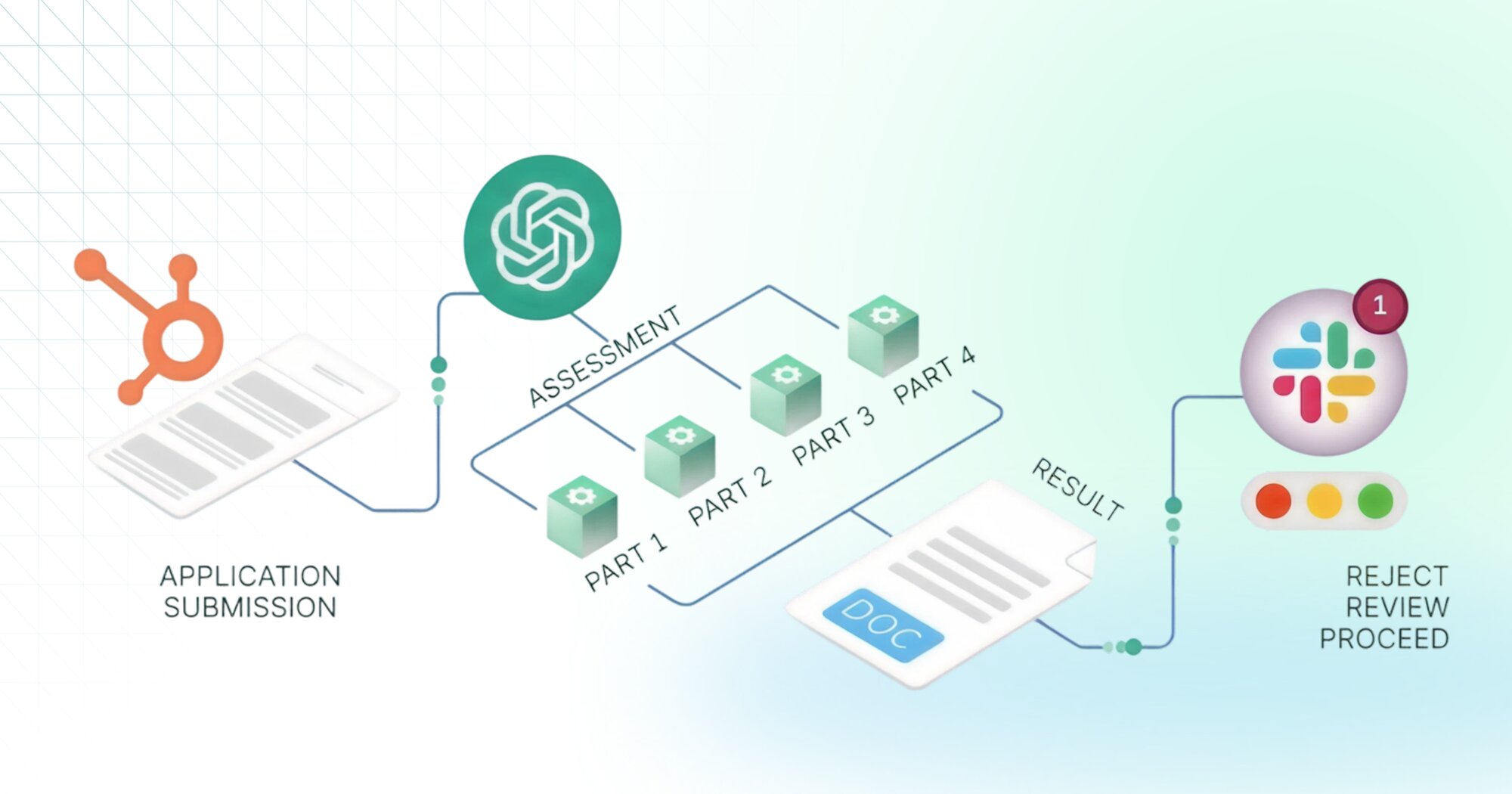
The fund's assessment criteria covered roughly 30 data points across four groups - financial feasibility, business model fit, market positioning, and overall viability. Rather than feeding everything into a single prompt (which produced inconsistent results and made failures impossible to isolate), we broke the evaluation into specialized agents. Each agent handles one criteria group, analyzing the pitch deck and supporting documents against specific assessment dimensions. A consolidation agent then weighs all outputs and produces the final report.
This mirrors a pattern we've applied across AI projects: smaller, focused agents with cleaner context windows produce more reliable outputs than monolithic prompts - and when something goes wrong, you know exactly where to look.
Structured, usable output.
The pipeline doesn't produce a thumbs-up or a score in a spreadsheet. It generates a full Google Doc - formatted to the fund's existing template - with scored assessments for each criteria group, supporting analysis, and a consolidated recommendation. An experienced partner can open that doc and make a decision in minutes rather than building the analysis from scratch.
Alongside the doc, a Slack notification fires with a short summary, a link to the report, and a green/yellow/red signal - telling partners at a glance whether to jump on a pitch immediately, schedule a review, or move on.
Integration without infrastructure overhead.
We connected the pipeline using Zapier, linking the fund's existing HubSpot submission form to the AI evaluation engine, Google Docs output, and Slack notifications. No new infrastructure, no complex deployment. This kept the project fast and meant the system could go live against real pitches immediately - which was critical for validating the AI's judgment against the team's own assessments.
Built for the fund to own.
The architecture was deliberately model-agnostic. The fund can swap in newer AI models as they become available - important in a space where model capabilities are improving month over month. More importantly, evaluation criteria and prompts are editable by the fund's assessment team directly, without touching code. As their investment thesis evolves, the assessment evolves with it.
The Results
The pipeline went from kickoff to production in under two weeks - an engineer and a product manager working in a focused sprint, iterating directly with the fund's assessment team against real pitch data.
What previously took an afternoon per pitch - reading, structuring, analyzing, writing up - now takes minutes. The fund can process roughly 10x the pitch volume they could before, and the structured output means senior partners spend their time on judgment calls, not document preparation.
The system is futureproofed. The fund iterates on their evaluation criteria as their thesis sharpens, swaps in newer models as they become available, and operates the pipeline day-to-day without developer support. When edge cases surface - an unexpected file format, a criteria adjustment - the compartmentalized architecture means fixes are surgical, not systemic.
For Whitespectre, this project demonstrates a pattern we see increasingly: organizations that have been experimenting with AI, have seen the potential, but need engineering rigor to turn experiments into something production-ready. The gap between an AI proof of concept and a tool you'd stake your deal flow on is a software engineering problem - multi-agent architecture, structured outputs, clean integrations, and a system the team can own long-term. That's the work.