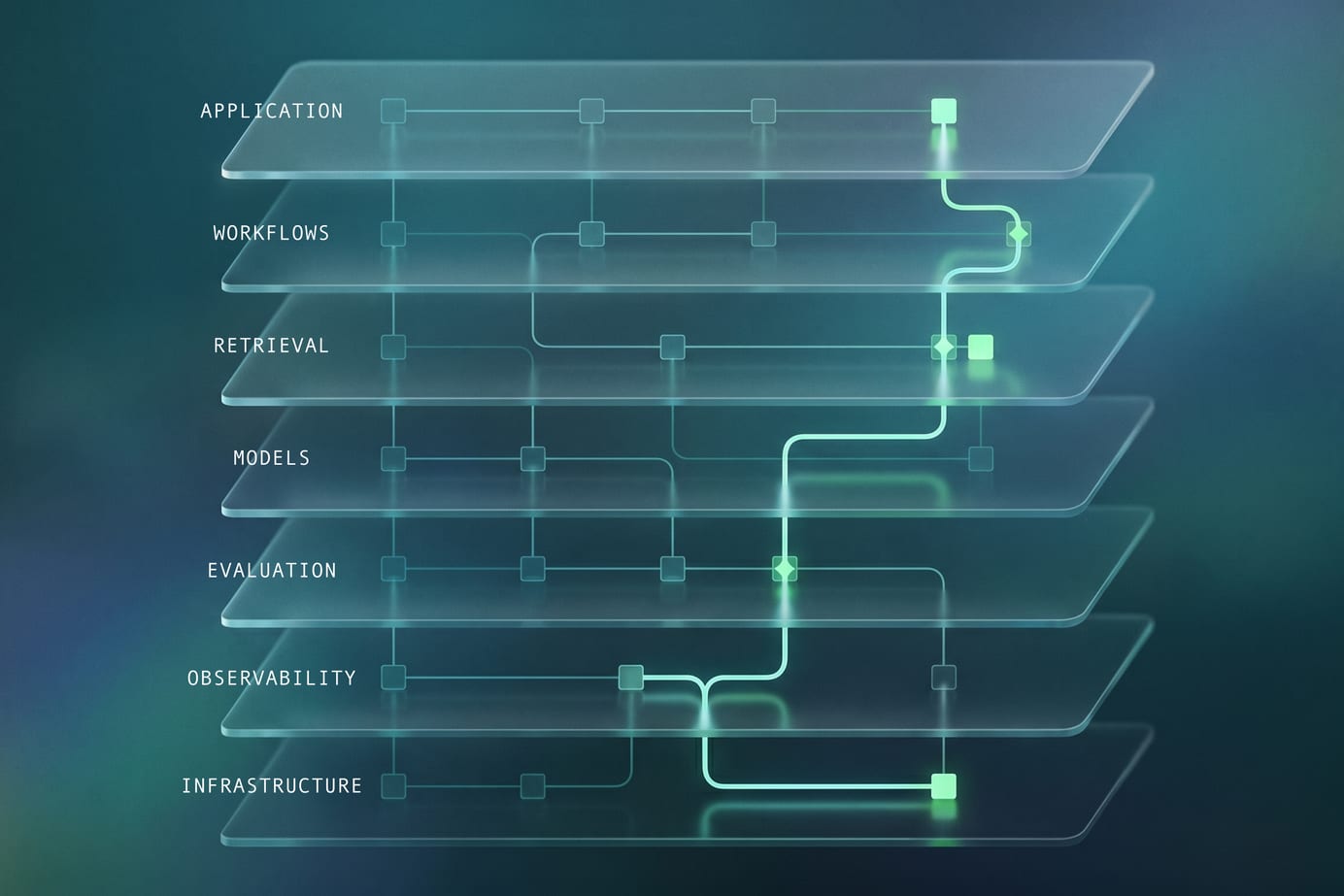
Most AI infrastructure decisions don't become expensive immediately. They become expensive later, when requirements change and the architecture is harder to untangle than anyone expected.
A team adopts provider-managed retrieval to move quickly. Six months later, they want to evaluate a different model provider for cost or latency reasons and discover retrieval is tightly coupled to the original stack. What looked like a model swap turns into a larger migration project.
That pattern shows up repeatedly in AI systems right now. Teams adopt orchestration frameworks that are difficult to unwind, tracing platforms built around assumptions that no longer fit the product, and evaluation systems before anyone knows what production quality actually looks like.
The challenge usually isn't choosing the wrong tool. It's committing too deeply before the product has stabilized enough to justify the decision.
At Whitespectre, we've found most AI infrastructure decisions fall into three categories: build, buy, or wait. The category matters less than understanding what becomes difficult to change later.
Build, Buy, or Wait
Early AI systems change quickly. Product requirements change even faster. That makes flexibility more valuable than optimization in the beginning.
A few heuristics have held up well for us:
| Situation | Usually the Better Choice |
|---|---|
| Requirements still changing | Build thin |
| Commodity operational problem | Buy |
| Unclear whether the capability matters yet | Wait |
| Switching costs could become painful later | Own the abstraction |
| Vendor category still shifting rapidly | Avoid deep integration |
None of these are permanent decisions. Most systems move through all three stages eventually.
Where Lock-In Actually Happens
One of the more common failure modes in AI systems is allowing application behavior to become provider-specific too early.
We worked with a team building AI-assisted workflows on top of a CMS-heavy backend maintained by non-technical operators. They chose OpenAI's built-in retrieval tooling because it minimized operational overhead. Chunking, embeddings, and search were all managed for them, and there was very little infrastructure to maintain internally.
For the initial product requirements, the decision made sense.
The problem appeared later when the team wanted to evaluate non-OpenAI models. Retrieval behavior — chunking, indexing, metadata structure, query semantics — had become tied to the provider's tooling. The migration stopped being a provider change and became a retrieval rewrite.
Inference gateways, external vector stores, and standardized tool interfaces make portability easier than it was a few years ago. But the underlying architectural issue still shows up frequently.
Teams rarely regret using managed infrastructure. They regret coupling the parts that are hardest to reconstruct later.
Build Thin While You're Learning
Teams often overbuy AI infrastructure before they understand their operational patterns.
This happens constantly with prompt management, tracing, orchestration, evaluation systems, and agent frameworks. The tooling ecosystem moves fast, demos are persuasive, and building internally can feel risky. But many of these systems only become useful once production behavior exists.
Before launch, teams rarely know:
- which traces matter during debugging
- which prompts need versioning
- which evaluation datasets correlate with real failures
- which workflows actually require human review
Most of that gets learned after deployment.
That's why lightweight internal tooling is often the better early decision — because teams need time to discover what they actually need before committing to a platform.
The important part is keeping the implementation narrow. Small surface area. Clear boundaries. Minimal abstraction. Straightforward replacement path.
If replacing a component later feels annoying, that's normal. If replacing it feels existential, the boundary is probably in the wrong place.
What This Looked Like in Practice
On Spot Coach — an AI assistant for SpotOn's GPS dog collar platform — we treated switching costs as a design constraint from the beginning.
Whitespectre has built and maintained SpotOn's Rails and Postgres platform since 2020. The assistant supports customer setup, troubleshooting, and personalized training guidance using both product documentation and live device data.
The retrieval layer uses Postgres full-text search — a fit for the operational reality: a bounded corpus, structured content, and a team already running Postgres in production. The corpus is 10 Markdown documents split on H1–H3 headings into chunks of about two thousand characters. Retrieval is a single GIN-indexed tsvector query run inline in the request cycle, with headings weighted above body text and the top seven chunks handed to the model. No embedding pipeline, no vector store, no separate service to keep in sync. At this size, ts_rank ordering is good enough that chunking and ranking quality, not infrastructure, set the ceiling.
The more important architectural decision was keeping retrieval behind a stable interface: query in, ranked chunks out. That keeps the surrounding application logic independent of the retrieval backend.
The team also built lightweight prompt versioning and request tracing directly into the Rails admin system. Each request logs prompt version, model metadata, tool usage, and request outcomes.
The decision came down to workflow uncertainty. Early on, the team didn't yet know which traces would matter operationally, how evaluations would fit into support workflows, or which metadata would become important later. And this category of infrastructure tends to expand — what starts as request logging can evolve into:
- Replay tooling
- Regression testing
- Evaluation pipelines
- Dataset curation
- Compliance review
Building internally gave the team room to discover which of those actually mattered before committing to a broader platform.
One example: at some point, we discovered that the assistant started 're-greeting' users mid-conversation. Without versioning, diagnosing that issue would have meant trying to figure out if it was a prompt change, or a model change that had triggered this. But because the team had versioning and rollback, it was easy to hold the prompt constant, confirm it was a model change that had triggered the issue, and adjust from there.
For provider abstraction, the team used RubyLLM. Changing providers became a configuration decision instead of an application rewrite.
That distinction matters because different parts of the AI stack are stabilizing at different speeds. Infrastructure around inference routing, observability, caching, rate limiting, and provider abstraction has matured considerably. Areas like agent orchestration, autonomous workflows, and generalized memory systems are still changing rapidly enough that deep platform commitments can become expensive surprisingly quickly.
Sequencing the Commitments
Most teams won't predict the right long-term AI stack upfront. The more useful skill is delaying irreversible decisions until operational patterns become clear — learning from production behavior first, keeping interfaces replaceable, and standardizing only after workflows stabilize.
Over time, components move between categories naturally. Something built internally early on may eventually get replaced by a vendor platform once the requirements become predictable. A capability that initially felt unnecessary may become critical once production usage grows. Sometimes a platform that accelerated the first version of the product becomes the thing slowing iteration later.
AI infrastructure will keep shifting for a while. Most teams are still figuring out which abstractions are durable and which are temporary.
The safest assumption right now is that requirements will move faster than the tooling landscape settles.
—
Whitespectre is a product-driven development company and technology consultancy. We help growth-stage and enterprise companies build and scale the software at the core of their business.